


A new paper on globalisation and political divides
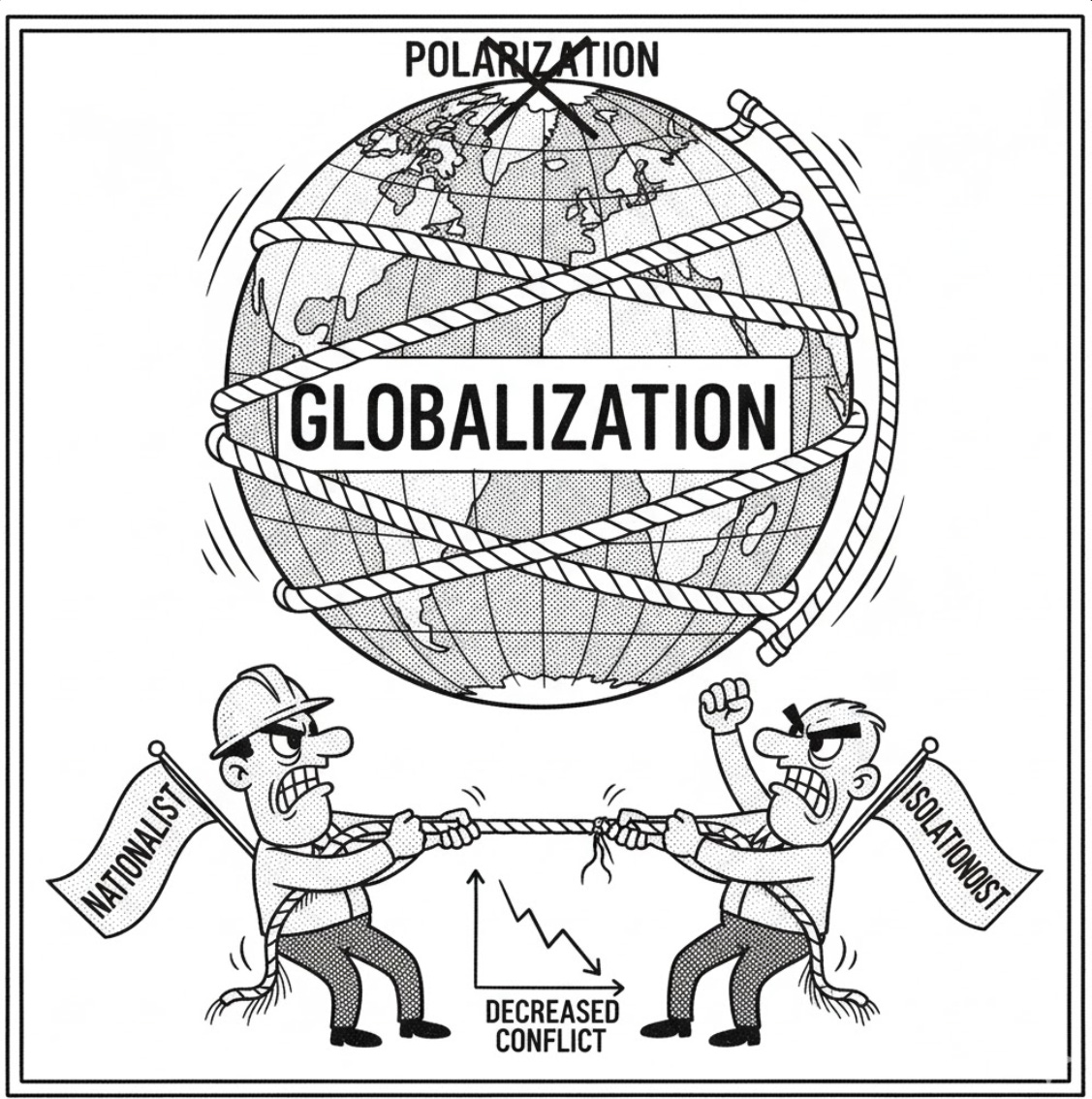
A recent paper examines whether globalisation reduces political polarisation. The question is interesting because public debate often assumes the opposite: that globalisation fuels divisions by exposing countries to economic shocks, cultural tensions, and external pressures. The paper challenges this assumption and proposes a more nuanced view.
The basic idea: integration can moderate conflicts
The central argument is that economic integration may reduce polarisation by creating shared interests across groups. Trade and investment exposure can broaden a country's economic base, and international cooperation may reduce the salience of ideological conflicts. Under this view, globalisation introduces incentives for moderation rather than for confrontation.
The authors argue that this mechanism deserves more attention than it usually receives. The theoretical link is plausible, but empirical work has been limited.
What the evidence shows
The paper employs several measures of globalization and compares them with indicators of political polarization across countries. The results suggest a negative relationship: higher levels of globalisation are associated with lower levels of polarisation.
In other words, more globalised countries tend to display less extreme political conflict. This result stands in contrast to the narrative that globalisation inevitably produces anger or political fragmentation.
Testing the robustness of the findings
The authors explore a wide range of robustness checks. They consider issues such as unobserved heterogeneity, omitted variable bias, outliers, and reverse causality. The main conclusions remain stable across specifications.
Although no single study can settle the debate, the pattern is consistent with the idea that international integration can have moderating effects on domestic politics.
Why this matters
Debates about globalisation often focus on dislocation and risk. These concerns are legitimate, but the exclusive emphasis on negative outcomes can distort the broader picture. Some of the most significant effects of globalization may be indirect: greater openness can reduce the incentives for extreme political behavior by increasing the economic and institutional links between groups.
If this interpretation is correct, policy discussions that frame globalisation solely as a destabilising force overlook an important stabilising dimension.
Conclusion
This new research suggests that, under many conditions, globalisation may alleviate rather than exacerbate political divides. The finding does not negate the existence of adjustment costs or distributional challenges, but it invites a more balanced view of how international integration interacts with domestic political dynamics.
References
Fang, Jianchun, Giray Gozgor, och Cheng Yan. ”Does globalisation alleviate polarisation?” The World Economy 44, nr 4 (2021): 1031–52. https://doi.org/10.1111/TWEC.13048.